
Welcome to Laughing Wolves
slow is smooth, smooth is fast
The Pack fight with each other with fun and respect



Laughing Wolves
HEMA Fencing Club
Weekly Practice Locations
🤺 🗡 🍔 Swords Slash & Sack
Saturday Morning 10:30 AM – 12:30 PM at Emerald Glen Park, Dublin
follows by enjoying your own Sack Lunch together
🍔 🥛 🍟 🍕 🥤 🥪 🥙
About Us
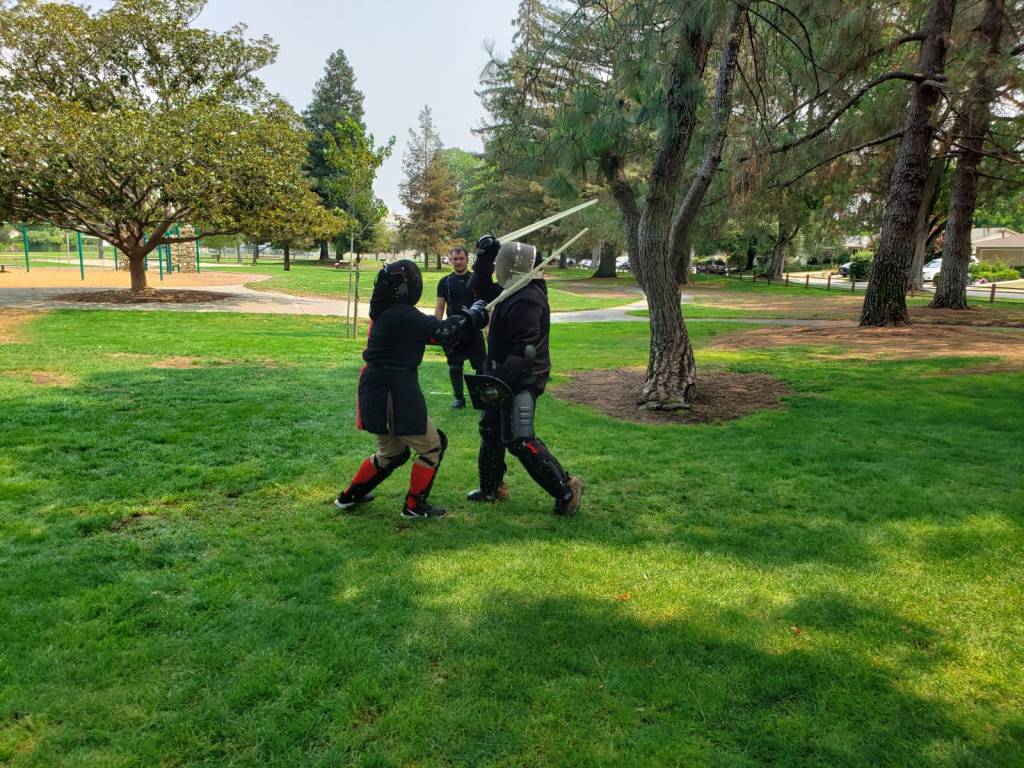
The Laughing Wolves HEMA Fencing Club teaches Historical European Martial Arts.
We teach the use of many weapons including, the longsword, saber, and rapier, lightsaber, etc. We use source material to do this and the years of experience from our instructors.
We enjoy the time learning new techniques and sparring with each other, in the indoor or outdoor setting, during morning or evening sessions.
🦠 Covid-19 and 🛡 Training
We are currently training, however in light of the ongoing Covid-19 pandemic we have made some adjustments to our schedule, procedures, and location. A face mask covering your nose and mouth is required unless you are fully vaccinated, at which point they are admired but not required. Our current plans are to stay in alignment with the CDC and California requirements.
Safety is our number one priority. Thank you for helping us keep each other safe.
What are we learning?
Italian Longsword
Fiore de Liberi’s ‘Flower of Battle’ was a combat manual covering wrestling, dagger combat, sword in one hand, sword in two-hand, spear, pole-axe, mounted combat, and more. Fiore’s work was useable in and out of armor- making his manual a complete study of Western Martial arts. Fiore’s work was published in 1410 for an influential military leader named D’Este and had four versions, the most popular being the Getty. Phillip Vadi later expanded upon his works in 1450, and he influenced later Italian masters in the use of the more giant two-handed swords. We focus on the sword in two hands.
Italian Rapier
From the late 1500s through the 1600s the rapier was a popular civilian weapon used for defense and duels. The Italians developed a series of manuals on the use of the rapier. We focus on the work of Nicoletto Giganti, who wrote ‘The School’in 1606. Giganti’s methodology is designed for students learning from the ground up and is written in an easy-to-understand style. For advanced work, we focus on Salvator Fabris’ epic 1606 manual, ‘The Science of Arms,’ something Giganti may have plagiarized and simplified- making the pair an excellent match to study.
Saber
The saber is an ancient weapon but was still prevalent in the 1800s and 1900s as both a military weapon and a sport or dueling weapon. Useful for cutting and, to some extent, thrusts, the weapon was popular on foot and horseback. Alfred Hutton created a society dedicated to reviving lost European swordsmanship and developed his ideas on using the saber. Hutton has his manual, ‘Cold Steel,’ published in 1889, and his custom-designed saber created. Hutton is associated with the Bartitsu Club, where his fencing organization was based for a time.
Dussack
The Dussack is a simple, short cutting weapon of which there are not many surviving examples. As such, it is unknown if Dusacks were common weapons of the 1500’s, or if they wThe Dussack is a simple, short-cutting weapon of which there are not many surviving examples. It is unknown if Dusacks were common weapons of the 1500s or geared toward training purposes. Dussacks were made of wood, leather, and metal and resemble a scythe blade or a large knife. Joachim Meyer’s manual ‘Thorough Description of the Art of Fencing’ was published in 1570 and covered the use of the Dussack and other weapons such as the longsword, dagger, and polearms.
FAQ
When can I start?
Welcome new wolf to any one of our classes. You will get a comprehensive review of HEMA and what our group does.
Where is class?
SWORDS SLASH & SACK
Sunday Morning 10:30 AM – 12:00 PM at Emerald Glen Park, Dublin
follows by enjoying your Sack Lunch together
What do I wear?
For your first class, wear comfortable workout clothes and shoes.
Note: we don’t provide protective cups for men, so please bring your own.
When you first come to the group, we will provide you with almost everything you need. We do suggest men and women might need their plastrons for the chest and protective gloves like ice hockey gloves.
What does it cost?
Currently, Our club is free to join and practice with us.
 Laughing Wolves HEMA Fencing Club